

How should we improve the NHS?
Give specific details of what could be done and how? Give examples of what is not working with proposed solutions. How could we leverage technology whilst also ensuring privacy?
Society Speaks turns noise into signal. We use machine learning to find where people actually agree, reveal bridge ideas that unite opposing groups, and surface genuine divisions worth addressing.
One carefully chosen question each day. Vote, share your reasoning, then see how others responded. Over time, this creates a longitudinal view of how public opinion evolves.
📧 Get 5 questions weekly by email (default) • Choose daily or monthly in preferences
We curate stories from trusted sources, filter out sensationalism, and turn them into balanced discussions. Real journalism as input to civic deliberation.
Stories from sources across the political spectrum.
AI scores articles for civic value, filtering out clickbait and sensationalism.
Each story generates seed statements representing multiple perspectives.
The Daily Brief delivers the news of the day you actually need to know about. 3-5 stories daily, each vetted for civic impact, analysed for partisan spin, and explained in plain language. See every angle, skip the outrage.
Published daily, email delivery optional
Multi-source coverage with left/centre/right breakdown
"Why This Matters" context for every story
"Under the Radar" stories others miss
News Transparency Dashboard - 140+ sources organised by political leaning
Because we're mission-driven, not ad-funded:
Society Speaks is committed to keeping our core tools open, public, and free. Sign up to access the Daily Brief and News Dashboard at no cost.
Society Speaks
Friday, 13 March 2026
News, analysis, think tanks, and podcasts—curated for quality journalism
News/Analysis Podcast | Bias ratings from AllSides | See all 140+ sources
Personal Briefs lets you create custom daily digests from the publications, Substacks, and PDFs you choose. Your subscription funds our open source civic platform.
Choose your own sources (RSS, Substack, PDFs)
AI-powered synthesis from multiple sources
Delivered on your schedule (daily or weekly)
Review and edit before sending (Team plans)
AI combines coverage from multiple publications you trust...
Throughout history, diverse voices have championed the power of dialogue and understanding.
"Never doubt that a small group of thoughtful, committed citizens can change the world; indeed, it's the only thing that ever has."
Cultural Anthropologist
"A critical, independent and investigative press is the lifeblood of any democracy."
South African President
"The peculiar evil of silencing the expression of an opinion is that it is robbing the human race."
Philosopher, 1859
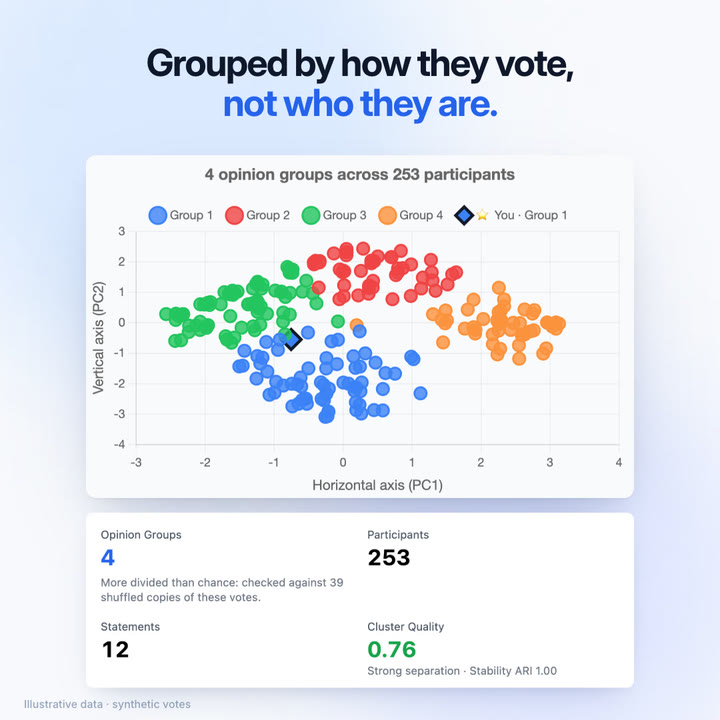
Unlike polls that just count votes, our machine learning clusters participants by their voting patterns. This reveals bridge statements—ideas that resonate across opposing groups—and shows where genuine consensus exists.
Traditional media amplifies division. We're building democratic infrastructure for understanding.
Machine learning clusters participants by voting patterns to surface consensus, find bridge ideas, and reveal genuine divisions. Disagree agreeably.
Connect with decision-makers and contribute to discussions that shape policy.
Our platform is designed to reduce polarization and help find common ground.
Join the conversation in three simple steps
Start a discussion or browse discussions by topic, location, or join a featured conversation
Vote on statements and contribute your own views to the conversation
See where opinions align and understand different viewpoints
Advanced clustering algorithms identify consensus statements and bridge ideas that unite opposing groups
Have constructive debate, disagree agreeably and understand nuance
See how the conversation evolves as more people participate and then share it with decision makers
Explore our most impactful discussions
Give specific details of what could be done and how? Give examples of what is not working with proposed solutions. How could we leverage technology whilst also ensuring privacy?
The UK is now a digital society sitting on privately run networks and global technology stacks. Cyber crime generates estimated losses of £14.7 billion annually — and a catastrophic cascade failure is a credible risk. How far should the state push baseline standards? How do we share burdens between firms, citizens and government? And how do we build an online "security state" — not a surveillance state?
Trust in government, public institutions and democratic processes has fallen sharply. Trust is often treated as a cultural problem — but it is more often an engineering problem: reliability, responsiveness, integrity and fairness. What practical steps should the UK take to rebuild the relationship between citizens and the institutions that serve them?
If the UK wants a growing workforce and enough staff for health, care, construction and technology, migration matters. If it wants lower migration, it must substitute through higher domestic training, higher participation and later retirement. There is no free option. How should the UK design a stable, honest long-term approach to immigration?
The UK is highly centralised — a model that is increasingly dysfunctional as local variation grows and demand for locally delivered services rises. Should we give regions and local areas meaningful fiscal power and accountability? What does a well-functioning, trusted state look like in the 2050s — and how do we get there?
Climate action is a practical necessity, but "climate policy" bundles different things: cutting emissions, preparing for impacts, and protecting nature. Is there a trade-off between decarbonisation and growth? How do we balance ambition with fairness — ensuring costs are not carried disproportionately by those least able to bear them?