Discussions · Programmes · Consensus Analysis

Nuanced debate.
Rigorous analysis.

Vote on statements. Discover where you agree with people you thought you didn't. See what the data actually reveals — not percentages, but clusters of real opinion.

What does it actually look like?

Each discussion presents clear statements on a real issue. You vote agree, disagree, or unsure — then see how your view compares to everyone else.

A discussion statement

🌱 Environment Featured

The UK's approach to net zero

"The UK should bring forward its net zero target from 2050 to 2040 to maintain climate leadership."

Statement 3 of 8

Agree
62%
Disagree
27%
Unsure
11%

Based on 1,247 votes — vote on 5 statements to unlock your cluster

How it works in 3 steps

1

Read a statement

Each discussion presents clear, balanced statements on a real issue — written to be fair to all sides. No leading questions, no loaded language.

2

Vote agree, disagree, or unsure

One tap. No essays, no point-scoring. Just your genuine position. You can add reasoning or evidence, but it's optional. Vote on 5 statements to unlock your cluster.

3

See how opinion actually clusters

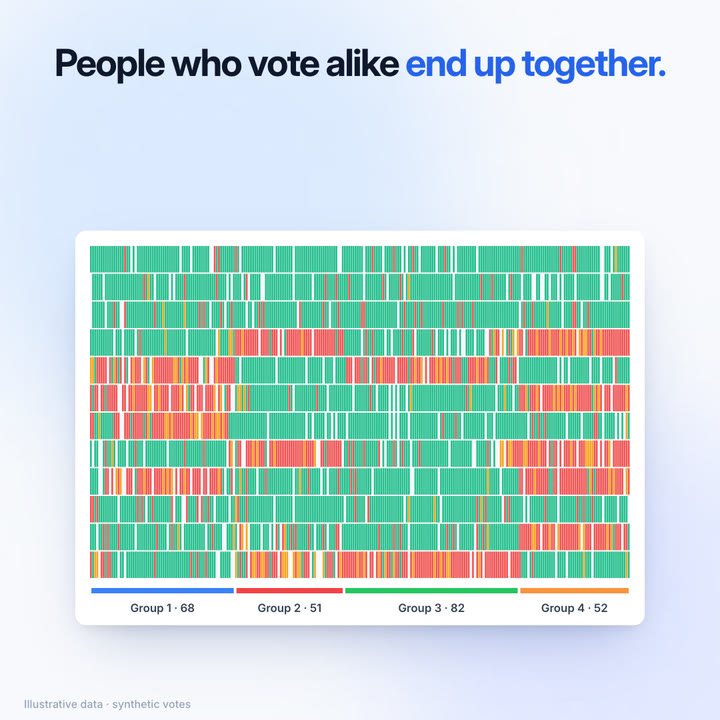
Once enough people have voted, machine learning groups participants by their actual voting patterns. You'll see which group you're in, what your group agrees on, and where surprising common ground exists.

Try it yourself — takes 2 minutes

Vote on our live demo discussion, then see what the consensus analysis reveals about how opinion clusters.

What consensus analysis reveals

Traditional polling gives you percentages. We show you how views actually cluster — revealing what divides people and, crucially, where they agree across lines.

Opinion clusters

Consensus Analysis — UK Net Zero Discussion

1,247 participants
Group A

612 people

Group B

412 people

Group C

223

ML clustering by voting pattern

Consensus All groups agree

"Investment in renewable energy creates more jobs than it destroys."

84% agree
Bridge Unites opposing groups

"Energy security and climate action can and should be pursued together."

Division Real fault line

"The cost of the transition should fall primarily on high-income households."

Why this matters

Opinion polls tell you that 62% of people agree with something. We tell you which people — and what those people agree on, disagree on, and what surprising common ground exists between groups who seem to be in opposition.

Consensus statements

Ideas with broad agreement across all groups — the genuine common ground that polls often miss.

Bridge statements

Ideas that unite people who otherwise disagree — the foundation for productive conversation across divides.

Genuine divisions

Real fault lines — the places where groups genuinely differ. Understanding these is the start of honest public debate.

Inspired by Pol.is — built for the UK

Our clustering approach is inspired by the open-source Pol.is methodology, adapted for deliberative democracy at any scale — from a local council to a national strategy consultation.

Why this matters now

We are living through a crisis of public discourse.

Social media rewards outrage over nuance. Opinion polls flatten complexity into percentages. Comment sections amplify the loudest voices. And governments run "consultations" that nobody reads. We built Society Speaks because the infrastructure for genuine public deliberation is broken.

The problem with polls

A poll tells you 62% of people agree with something. It doesn't tell you which 62%, how strongly they feel, whether they have anything else in common, or whether that 62% is actually six different groups who agree for completely different reasons.

The problem with comment sections

Comment sections are dominated by the most motivated, most extreme, and most available voices. They create the illusion of discourse while actively suppressing it. The quiet majority rarely speaks — and when it does, it's drowned out.

The problem with consultations

Government and corporate consultations generate thousands of unstructured submissions. They are expensive to analyse, easy to game with organised campaigns, and almost never result in a usable picture of where genuine public agreement lies.

Our methodology

Built on opinion clustering — not polling

Society Speaks uses a machine learning technique called opinion clustering (based on principal component analysis of voting patterns) to group participants not by who they are, but by how they actually vote on statements. This reveals the genuine structure of public opinion.

Once participants vote on enough statements, the algorithm identifies natural clusters — groups of people who vote similarly. It then classifies each statement as:

  • Consensus — agreed on across all groups, regardless of other differences
  • Bridge statements — where otherwise opposing groups converge, revealing unexpected common ground
  • Genuine divisions — where groups strongly diverge, identifying real fault lines worth understanding

This approach is resistant to organised manipulation — coordinated campaigns show up as a distinct cluster rather than distorting the overall picture. It also surfaces the silent majority: participants who never comment but whose votes carry equal weight.

Built on Pol.is — and beyond

We stand on the shoulders of pioneers

Pol.is pioneered this approach and used it for Taiwan's vTaiwan participatory democracy process — one of the most successful examples of digital deliberation in history. We are inspired by that work and the open-source research behind it.

Society Speaks builds on the core clustering insight and takes it further for structured, institutional use:

Native statement curation

Statements are reviewed, balanced, and AI-assisted — ensuring quality and fairness rather than surfacing the most popular submitted statements

Programmes — structured multi-discussion campaigns

Group many discussions into phases, themes, and cohorts — enabling full consultation campaigns, not just one-off conversations

Evidence-linked reasoning

Participants can attach evidence and reasoning to their votes — moving beyond a binary to a richer record of why people think what they think

Publisher and partner integration

Embed discussions directly in news articles, policy documents, and websites — meeting participants where they already are

How we compare

Feature Society Speaks Pol.is YouGov / Polling Stanford Deliberation Standard Consultation
Opinion clustering (ML)
Structured programmes / phases ~
Embeddable in websites
Evidence-linked reasoning
Open to public participation Panel only Invited only ~
Free to use
Curated, balanced statements ~
Full data export (CSV/JSON) Paid only
Scalable — from 10 to 100,000 participants Expensive at scale Academic, small-scale Unwieldy at scale

~ = partial or limited capability

Discussions happening now

Real discussions on real issues — join in and see where opinion clusters.

See all discussions
Healthcare Featured

How should we improve the NHS?

Give specific details of what could be done and how? Give examples of what is not working with proposed solutions. How could we leverage technology whilst also ensuring privacy?

United Kingdom

Programmes

One discussion is a conversation.
A Programme is a consultation.

A Programme groups multiple discussions into one structured campaign — with shared themes, phases, participant cohorts, and full data export. Used by organisations and governments for everything from stakeholder consultations to national strategy dialogues.

  • Themes — Housing, Transport, Economy. Filter and compare across topics.
  • Phases — Listening → Deliberation → Recommendations. Structured consultation flow.
  • Cohorts — Compare views across regions, demographics, or stakeholder groups.
  • Export — Full CSV/JSON data export per cohort for your own analysis.

Programme · Example

Housing & Planning Consultation

Regional consultation on housing supply, planning reform, and affordability

Phase 2 of 3
🏠 Supply 📋 Planning 💷 Affordability +2 more

8

Discussions

2,419

Participants

4

Cohorts

What this generates

Consensus report per discussion Full CSV/JSON export Cohort breakdown

Who it's for

Same platform. Same rigour. Works differently for each audience.

Individuals

Citizens, activists, students, curious people

Take a position on issues that matter to you. See where you stand relative to others — not just as a percentage, but as part of a cluster of people who think like you. Discover where you have more in common with other groups than expected.

  • Vote on national, local, and topic-specific discussions
  • Add your own statements and reasoning with evidence
  • Contribute to discussions that inform policy and public debate
  • Start your own discussion on any topic — free

Businesses, Podcasts & Creators

Brands, media, podcasters, newsletter writers

Your audience has opinions. Society Speaks lets you surface them properly — not with a poll or a comment section, but with structured debate and real analysis. Find out what your audience actually agrees on, and what genuinely divides them.

  • Create discussions around your content and topics
  • See where your audience clusters, agrees, and divides
  • Build an organisation or brand profile to host your discussions
  • Embed discussions on your own site — no moderation needed
Example: A podcast creates a discussion around a controversial episode topic. Listeners vote on statements, and the hosts see where their audience clusters — who agrees on what, and what genuinely divides them. Better signal than comments. Citable data.

Organisations & Think Tanks

NGOs, councils, research bodies, companies

Run structured public or stakeholder consultations with full control over who participates and what gets asked. Create a Programme to group discussions by theme, organise them into phases, and export the full dataset for your own analysis.

  • Multi-topic consultations grouped under one Programme
  • Public, unlisted, or invite-only access control
  • Invite stewards, co-managers, and participant cohorts
  • Export CSV/JSON data per cohort for further analysis

Governments & National Bodies

Departments, strategy offices, democratic institutions

Run deliberative polling at national or regional scale. Map what the population agrees on, where genuine divisions lie, and what bridges opposing views. Get structured evidence to inform policy — not just percentages, but clustered insight.

  • Multi-topic, multi-phase national consultations
  • Compare views across regions, cohorts, and demographics
  • Structured evidence: consensus, bridge statements, divisions
  • Used for national strategy, citizen assemblies, public consultation

In use: National Strategy Project

The National Strategy Project is using Society Speaks to run national dialogue on the UK's long-term future — mapping where citizens agree, disagree, and where common ground exists across divides.

Visit the National Strategy Project

Get set up

Set up your presence on Society Speaks

Profiles take a few minutes to create and are free. Choose the type that fits how you want to use the platform.

Individual Profile

Best for: citizens, researchers, journalists, activists

What your profile includes

  • A public page with your name, bio, and all hosted discussions
  • Links to your website, newsletter, or social profiles
  • Areas of interest — so people can find discussions you run
  • Free — no subscription, no time limit
Create an individual profile

Organisation Profile

Best for: NGOs, councils, think tanks, media, podcasts

What your profile includes

  • A branded page with your logo, description, and mission
  • All discussions and Programmes listed under your brand
  • Team access — invite co-managers and stewards
  • Embed discussions on your own site under your brand
Create an organisation profile

Common questions

Frequently asked questions

Is Society Speaks free to use?

Yes — participating in discussions, creating discussions, and creating individual and organisation profiles are all free. Programmes are also free for most use cases. For large-scale institutional deployments with dedicated support, white-labelling, or advanced integrations, get in touch.

How do I start a discussion?

Sign in or register, then click "Start a discussion". You'll give it a title, description, topic, and geographic scope. You can either write the opening statements yourself or use our AI assistant to generate a balanced set of statements. You choose whether the discussion is public, unlisted, invite-only, or private.

Can I host discussions as my organisation rather than as an individual?

Yes. Create an organisation profile and then link discussions and Programmes to it. Participants will see your organisation's name, logo, and description as the host — rather than your personal account. You can also invite colleagues as co-managers so the whole team can administer discussions under one brand.

How many participants do I need before the consensus analysis works?

The clustering algorithm needs enough data to identify meaningful groups. In practice, you'll start to see clear patterns from around 30–40 active participants (people who have voted on at least 5 statements). The analysis becomes significantly more reliable with 100+ participants, and very robust at 500+. Each participant needs to vote on at least 5 statements to be included in their cluster.

Are votes anonymous? Who can see what I voted?

Individual votes are private — no one can see how you specifically voted on any statement. What is visible is the aggregate result: the percentage breakdown of agree/disagree/unsure across all participants, and the cluster groupings. The consensus analysis shows which cluster you belong to, but does not reveal your individual votes to other participants or the discussion host.

What is a Programme and how does it differ from a discussion?

A discussion is a single conversation on one topic. A Programme is a structured campaign that groups many discussions together — for example, a national consultation on housing policy might have separate discussions on planning, affordability, social housing, and landlord regulation. Programmes support phases (e.g. Listening → Deliberation → Recommendations), themes, and participant cohorts, with a single export of all data.

Can I embed Society Speaks discussions on my own website?

Yes. Publishers and partners can embed a voting widget directly into any webpage — a news article, policy document, or campaign page. Participants can vote without leaving your site. All votes feed into the same consensus analysis. See the publisher hub for setup instructions.

Can I keep my discussion private or invite-only?

Yes. When creating a discussion you choose the visibility: Public (anyone can find and join), Unlisted (accessible via link but not listed publicly), Invite-only (participants must be invited by email), or Private (only accessible to the creator and invited participants). This applies to Programmes too.

Can I export the data from my discussion?

Yes. Discussion creators and Programme managers can export all vote data as CSV or JSON — including per-statement results, participant clusters, and cohort breakdowns. This lets you do your own analysis, feed results into reports, or archive everything outside the platform.

How is Society Speaks different from a standard survey tool like SurveyMonkey?

Survey tools give you aggregate responses — percentages and averages. Society Speaks reveals the structure of opinion: how views cluster, which ideas bridge opposing groups, and where genuine fault lines lie. It's also open to public participation by default, and participants can add their own statements and reasoning — making it a genuine deliberative tool rather than a data collection exercise.

Still have questions? Email us or read the docs.

More than a poll. Better than a comment section.

Traditional polling gives you percentages. Comment sections amplify the loudest voices. Society Speaks shows you how views actually cluster — and where genuine common ground lies. Inspired by Pol.is, built for deliberative democracy at any scale.