Daily Question
One question a day. Vote, reflect, then see how others responded. Builds a longitudinal picture of public opinion.
Today's question →Free civic infrastructure
Civic infrastructure for structured public judgement — and the daily habits that feed it.
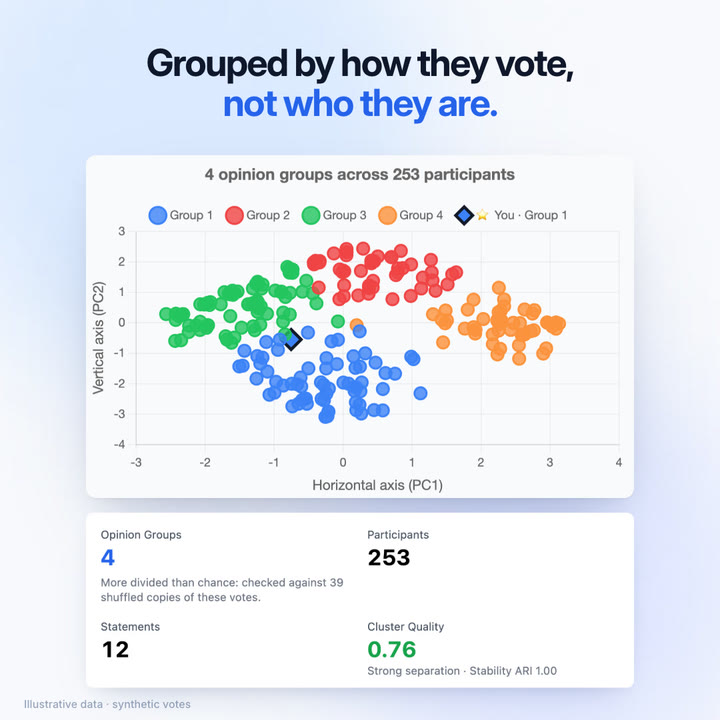
Online debate tells you who is loudest. It rarely tells you what most people think.
Society Speaks starts with a statement and three buttons.
You can agree, disagree, or say you are unsure. Each vote takes a second, and you do not need an account.
As the votes come in, people are grouped by how they vote, not by who they are. Then it shows you three things.
First, where people agree. Second, the ideas that win support in every group. And third, where the real divisions lie.
Every figure carries its margin of error, and the code is open for anyone to check.
For readers, there is a question to answer each day, and a free daily brief that shows how left, centre and right are covering the news.
And if you want more, a paid personal brief turns the sources you choose into one email each morning.
For publishers, the same voting sits under an article, in place of the comment section.
Councils and public bodies can run a full consultation, across several questions at once.
And now any organisation can run one itself, with a 14-day free trial. Ask one question, then share a link or put a QR code on the big screen. The report shows where your audience agrees, disagrees, is unsure or is split.
There is even a daily game, where you govern and every choice costs something.
Society Speaks. Making disagreement useful again.
The problem
Most public debate online rewards speed, outrage, and tribal certainty — so people often believe they disagree more than they do. Better decisions need a clearer picture of where communities align, where they split, and which ideas can bridge the gap.
Our theory of change
We are building towards a more accurate, transparent view of public opinion on the issues people engage with here — not another comment section, but a shared reasoning layer. Each product is a step in the same chain.
Meet people where curiosity already is — brief, question, play, or journey.
Tradeoffs · Daily Question · Daily Brief · Big Questions Journey
Vote on clear statements — often before seeing crowds, so your view is yours first.
Discussions · programmes you run · publisher embeds
Machine learning groups people by voting patterns, not labels — then surfaces structure in the results.
Individuals see the full shape of opinion; institutions see evidence they can cite and export.
Better-informed citizens, journalism, research, and policy — plus consultations you host on our infrastructure.
We are honest about limits: analysis needs enough participants; Tradeoffs measures responses to fiction, not your ideology; org exports are aggregate. Progress is cumulative — one question, one programme, one consultation at a time.
Three design choices behind the chain above — methodology inspired by Pol.is / the Computational Democracy Project.
Single claims, Agree / Disagree / Unsure — not threaded outrage.
Many surfaces hide aggregates until you have voted, reducing anchoring.
Clusters form from votes, not demographics — then feed the reveal step below.
For members, staff, conferences, podcasts and debates
Ask one question. Your audience answers a dozen short statements on their phones. You get a report of where they agree, disagree, are unsure or are split, ready to share.
Try Society Speaks with your real audience, free for 14 days. The complete experience and report. No card needed. Continue for £99 for 30 days or £600 a year.
For civic tech builders
Society Speaks is not only a public square — it is civic infrastructure you can deploy. Launch structured consultations, citizen assemblies, research panels, publisher embeds, and internal strategy processes using the same deliberation engine we use on societyspeaks.io.
Three distinct types of insight — not a single vote count:
Broad agreement across opinion clusters — including groups that disagree elsewhere.
Statements that resonate across clusters that otherwise split — often the most useful for policy and dialogue.
Clear fault lines where deeper deliberation is needed — surfaced honestly, not hidden.
Free civic tools for everyone. Premium Briefs and partnerships fund the commons.
One question a day. Vote, reflect, then see how others responded. Builds a longitudinal picture of public opinion.
Today's question →Free digest of 3–5 civic stories from 140+ sources with left/centre/right breakdown and why each story matters.
Read today's brief →Five turns of governing under pressure — discover what kind of leader you become when every choice helps someone and hurts someone else.
Play today →8 themes, country editions, at least 56 seed statements — vote across climate, AI, democracy, health, and more, then see your recap.
Start the journey →Topic-based deliberation on news and community issues — create your own or join open conversations.
Explore discussions →Today's news across the spectrum — sensationalism scores, coverage balance, and source transparency.
Open dashboard →Paid custom digests from your RSS feeds, Substacks, and PDFs — subscriptions fund the free civic platform.
Explore Personal Briefs →Curated civic news and spectrum transparency feed the Engage step — then seed statements and discussions carry issues into structured participation.
How we source news for debate →Public deliberation on Society Speaks is free: discussions, voting, the Daily Brief, and the Daily Question.
Individual votes and responses are never sold and never licensed to anyone. Only aggregate, anonymised patterns — what society agrees on, where it divides, how judgement shifts over time — may be licensed to institutions, and that revenue keeps the platform free and ad-free.
No advertising, no selling your data. Civic features stay free thanks to donations, Personal Brief subscriptions, and publisher partner plans.
Make a donationTake the Journey, answer today's question, or launch your own consultation on our infrastructure.