Consultation report
How should we use next year’s surplus?
Riverside Members Club · Members · 8 October 2026 – 15 October 2026
- Took part
- 164
- Votes cast
- 1,888
- Statements
- 12
- Response rate
- 39%
At a glance
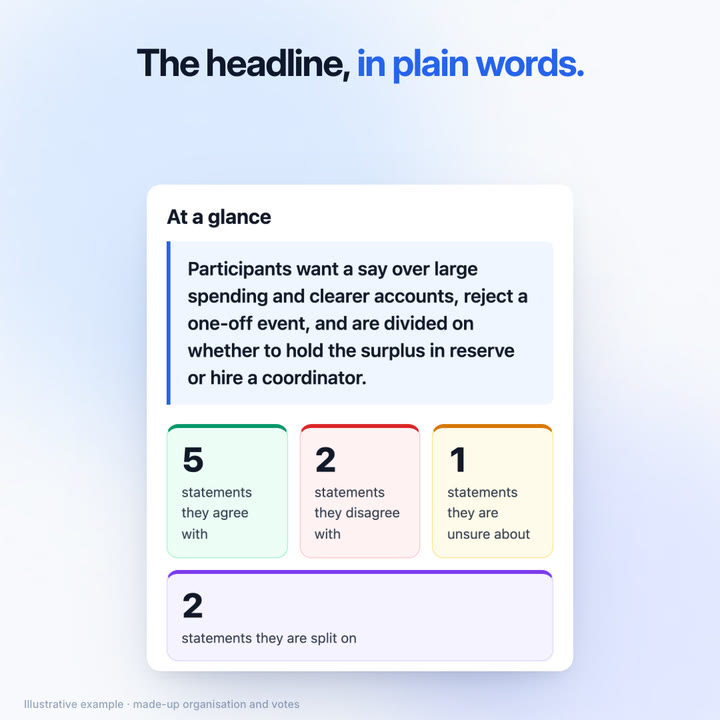
Participants want a say over large spending and clearer accounts, reject a one-off event, and are divided on whether to hold the surplus in reserve or hire a coordinator.
Every statement, every vote
| Where participants agree | ||
|---|---|---|
| We should publish a plain-English summary of the accounts every year. | 139 agree · 89% (83.2%–93.1%) 6 disagree · 4% (1.8%–8.1%) 11 unsure · 7% (4.0%–12.2%) | |
| Members should vote on any spending above £10,000. | 130 agree · 81% (74.5%–86.5%) 14 disagree · 9% (5.3%–14.1%) 16 unsure · 10% (6.2%–15.6%) | |
| Some of the surplus should go on lower fees for members. | 112 agree · 71% (63.4%–77.4%) 27 disagree · 17% (12.0%–23.7%) 19 unsure · 12% (7.8%–18.0%) | |
| A small grant fund for member projects would be money well spent. | 98 agree · 63% (55.0%–70.0%) 31 disagree · 20% (14.4%–26.8%) 27 unsure · 17% (12.2%–24.0%) | |
| We should refurbish the main hall before anything else. | 96 agree · 62% (53.7%–68.8%) 38 disagree · 24% (18.3%–31.7%) 22 unsure · 14% (9.5%–20.4%) | |
| Where participants disagree | ||
| The committee should decide how to use the surplus without a member vote. | 17 agree · 11% (6.7%–16.4%) 131 disagree · 82% (75.2%–87.1%) 12 unsure · 8% (4.3%–12.7%) | |
| We should spend the surplus on a one-off event for members. | 22 agree · 14% (9.4%–20.2%) 118 disagree · 75% (67.4%–80.8%) 18 unsure · 11% (7.3%–17.3%) | |
| Where participants are unsure | ||
| We should merge our reserves with the regional federation’s fund. | 31 agree · 20% (14.4%–26.8%) 36 disagree · 23% (17.2%–30.3%) 89 unsure · 57% (49.2%–64.6%) | |
| Where participants are split | ||
| We should hire a part-time coordinator with the surplus. | 68 agree · 43% (35.6%–50.8%) 72 disagree · 46% (38.0%–53.3%) 18 unsure · 11% (7.3%–17.3%) | |
| The surplus should stay in reserves until the lease is renewed. | 70 agree · 44% (36.8%–52.1%) 65 disagree · 41% (33.8%–48.9%) 23 unsure · 15% (9.9%–20.9%) | |
| No clear result | ||
| The surplus should be split equally between fees and the building. | 74 agree · 47% (39.8%–55.2%) 49 disagree · 31% (24.6%–39.1%) 33 unsure · 21% (15.5%–28.2%) | |
| We should keep fees the same and improve what members get instead. | 79 agree · 51% (42.9%–58.4%) 52 disagree · 33% (26.4%–41.0%) 25 unsure · 16% (11.1%–22.6%) | |
Agree Disagree Unsure
Each line is the count, the share of people who voted on that statement, and the 95% interval on that share.
Clear enough to call
These numbers count statements, not votes.
Control and openness
Participants agree that members should vote on large spending and that the accounts should be published in plain English.
Giving something back to members
Participants agree with lower fees and with a grant fund for member projects.
What they do not want
Participants disagree with a one-off event and with the committee deciding alone.
Reserves and staffing
Participants are divided on keeping the surplus in reserve and on hiring a coordinator.
Where participants agree 5
A clear majority agreed with these statements.
-
We should publish a plain-English summary of the accounts every year.
139 agree · 89% (83.2%–93.1%) 6 disagree · 4% (1.8%–8.1%) 11 unsure · 7% (4.0%–12.2%) 156 votes
-
Members should vote on any spending above £10,000.
130 agree · 81% (74.5%–86.5%) 14 disagree · 9% (5.3%–14.1%) 16 unsure · 10% (6.2%–15.6%) 160 votes
-
Some of the surplus should go on lower fees for members.
112 agree · 71% (63.4%–77.4%) 27 disagree · 17% (12.0%–23.7%) 19 unsure · 12% (7.8%–18.0%) 158 votes
-
A small grant fund for member projects would be money well spent.
98 agree · 63% (55.0%–70.0%) 31 disagree · 20% (14.4%–26.8%) 27 unsure · 17% (12.2%–24.0%) 156 votes
-
We should refurbish the main hall before anything else.
96 agree · 62% (53.7%–68.8%) 38 disagree · 24% (18.3%–31.7%) 22 unsure · 14% (9.5%–20.4%) 156 votes
Where participants disagree 2
A clear majority disagreed with these statements.
-
The committee should decide how to use the surplus without a member vote.
17 agree · 11% (6.7%–16.4%) 131 disagree · 82% (75.2%–87.1%) 12 unsure · 8% (4.3%–12.7%) 160 votes
-
We should spend the surplus on a one-off event for members.
22 agree · 14% (9.4%–20.2%) 118 disagree · 75% (67.4%–80.8%) 18 unsure · 11% (7.3%–17.3%) 158 votes
Where participants are unsure 1
“Unsure” was the most common answer to these statements.
-
We should merge our reserves with the regional federation’s fund.
31 agree · 20% (14.4%–26.8%) 36 disagree · 23% (17.2%–30.3%) 89 unsure · 57% (49.2%–64.6%) 156 votes
Where participants are split 2
Agreement and disagreement were both substantial, and close to each other.
-
We should hire a part-time coordinator with the surplus.
68 agree · 43% (35.6%–50.8%) 72 disagree · 46% (38.0%–53.3%) 18 unsure · 11% (7.3%–17.3%) 158 votes
-
The surplus should stay in reserves until the lease is renewed.
70 agree · 44% (36.8%–52.1%) 65 disagree · 41% (33.8%–48.9%) 23 unsure · 15% (9.9%–20.9%) 158 votes
No clear result 2
The votes lean one way, but not clearly enough to call.
-
The surplus should be split equally between fees and the building.
74 agree · 47% (39.8%–55.2%) 49 disagree · 31% (24.6%–39.1%) 33 unsure · 21% (15.5%–28.2%) 156 votes
Leans towards agreement.
-
We should keep fees the same and improve what members get instead.
79 agree · 51% (42.9%–58.4%) 52 disagree · 33% (26.4%–41.0%) 25 unsure · 16% (11.1%–22.6%) 156 votes
Leans towards agreement.
Suggested next questions
These are suggestions for what to ask or look into next. They are not findings.
- What is unclear, or still open, about merging reserves with the regional federation’s fund?
- What lies behind the division over holding the surplus until the lease is renewed?
- Which fees matter most to members?
How many took part, and what this does not show
- These results describe the 164 people who took part. People choose whether to take part, so participants may differ from those who did not. This is not a poll of everyone who was invited, or of the public.
- A clear agreement or disagreement is called only when the 95% lower bound on that share is a majority of the people who voted. A split is called only when both sides have a lower bound of at least 25% and the two sides are within 15 percentage points. Each statement is judged on its own. With few votes, even a large majority stays “no clear result”, and the interval shows why.
- Percentages are of everyone who voted on that statement, including those who answered “unsure”. People could skip statements, so the number of votes differs between statements.
- Taking part was anonymous, with one set of answers per device. Someone using two devices would be counted twice.
- This example uses made-up votes. In your report every figure is counted directly from the votes; the headline, themes and suggested questions are written by AI from those results and checked by software, so they describe the results and do not add to them.