For members, staff, conferences, podcasts and debates
Find out where your audience really stands.
Ask one question. Your audience answers a dozen short statements on their phones. You get a report of where they agree, disagree, are unsure or are split, ready to share.
Try Society Speaks with your real audience, free for 14 days. The complete experience and report. No card needed. Continue for £99 for 30 days or £600 a year.
- 5 min
- to set up, with statements drafted for you
- 2 min
- for each person to answer, on a phone
- 0
- logins, apps or names asked of them
Try it: tap an answer
Riverside Members Club
How should we use next year’s surplus?
Statement 1 of 4
Members should vote on any spending above £10,000.
A made-up example. Nothing you tap is recorded. Answer all twelve on your phone →
How it works
From question to report in three steps
A consultation is one question, about a dozen short statements that people agree or disagree with, and the report that comes out of their answers.
Read what the film shows
Ask one question.
We draft the statements.
You edit and approve them.
Put the code on the big screen.
Two minutes on a phone. No login. Anonymous.
Then show the room where it stands.
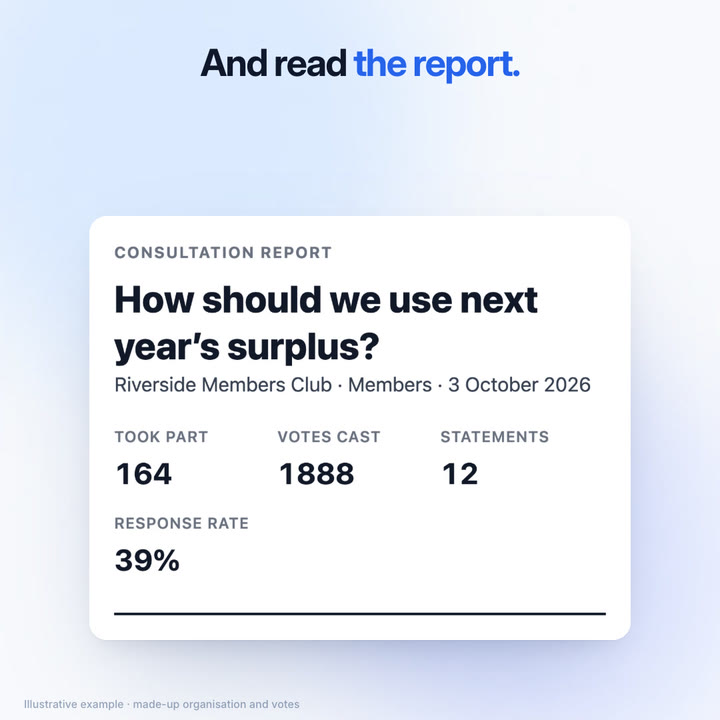
And read the report.
Where they agree. Where they disagree. Where they are unsure. And where they are split.
Free for 14 days. No card.
See where your audience agrees, disagrees or is unsure.
-
01
Ask your question
Tell us what you want to know. We draft a balanced set of short statements. Edit them, remove them, add your own, or write them all yourself.
About five minutes.
-
02
Share a link or QR code
People answer Agree, Disagree or Unsure, one statement at a time. No login, no app, nothing to install.
About two minutes each.
-
03
Get the report
What they agree on, what they reject, where they are unsure and where they are split, with the numbers and the statements behind each finding.
Built the moment voting closes.
What the data looks like
A poll gives you a number. This gives you the picture.
A poll answers the question you thought to ask. A consultation covers your question from a dozen angles and sorts every statement into one of four findings.
A poll
Should we spend the surplus?
Yes 58% · No 42%
A consultation
164 members, twelve statements
How should we use next year’s surplus?
They agree
- We should publish a plain-English summary of the accounts every year. 89% agree
- Members should vote on any spending above £10,000. 81% agree
- Some of the surplus should go on lower fees for members. 71% agree
- A small grant fund for member projects would be money well spent. 63% agree
- We should refurbish the main hall before anything else. 62% agree
They disagree
- The committee should decide how to use the surplus without a member vote. 82% disagree
- We should spend the surplus on a one-off event for members. 75% disagree
They are unsure
- We should merge our reserves with the regional federation’s fund. 57% unsure
They are split
- We should hire a part-time coordinator with the surplus. agree, then disagree:43% / 46%
- The surplus should stay in reserves until the lease is renewed. agree, then disagree:44% / 41%
No clear result
- The surplus should be split equally between fees and the building. agree, then disagree:47% / 31%
- We should keep fees the same and improve what members get instead. agree, then disagree:51% / 33%
Four findings, and what you can do with each
- Where they agree
- A clear majority of the people who took part agreed. One way to use it Share it as common ground, and build from there.
- Where they disagree
- A clear majority of the people who took part disagreed. One way to use it Say what you heard, and whether the idea stays on the table.
- Where they are unsure
- Unsure was the largest response. People may be ambivalent, or the statement may be unclear. One way to use it Explain it more clearly or reword it, then ask again.
- Where they are split
- Agreement and disagreement were both substantial and close. That is different from being unsure. One way to use it Find out what each side is worried about before anything is settled.
Each finding describes the people who took part, on that statement. It does not describe everyone you invited. Suggestions are marked as suggestions. What you decide stays with you.
Examples
Use it when you need to know where people stand
Situations you may recognise: the question each organisation asked, what it found, and what that let it do next.
Events and conferences
The situation
Three hundred people, one panel, forty minutes. The same five would ask all the questions.
The question
What should our sector do about AI this year?
- Shared
- QR code on the opening slide of the closing panel
- Took part
- 118
What they found
Those who answered want a written AI policy, not a ban. Most are unsure how AI tools use their data.
-
They agree
Every organisation here needs a written AI policy this year.
78% agree 10% disagree 12% unsureOne way to use it: Open the panel with it, and move on to what the policy should say.
-
They disagree
We should stop using AI tools until regulation catches up.
11% agree 76% disagree 13% unsureOne way to use it: Spend the panel’s time on something other than a ban.
-
They are unsure
I understand how AI tools use my organisation’s data.
17% agree 20% disagree 63% unsureOne way to use it: Plan a follow-up session on data.
-
They are split
AI will cut the number of jobs in our sector within five years.
42% agree 40% disagree 18% unsureOne way to use it: Hand the split to the panel as its first question.
Made-up examples, not customer results. The figures are sorted into findings by the same rules as a real report.
Live audiences
Put the code on a slide. Know where the room stands before the session ends.
A show of hands tells you who is confident enough to be seen. This hears from everyone who answers, including people who would never raise a hand.
Each talk is its own question and its own report. A 30-day pass covers every talk you run in that time.
- 0:00 The code goes on screen One click opens a full-screen view with your question, the QR code and a live count of who has answered.
- 0:30 The room starts answering No login and no app, so nobody is left behind. One tap per statement, and it is anonymous.
- 2:00 Reveal the results on the same screen One key switches from the code to the results, sorted into the four findings. You choose the moment, so nobody is swayed while they are still answering.
- After Close voting and the report is built Read the headline out before people leave, then send the link round.
Let the room add to it. Switch on suggestions and people can propose statements of their own. Each one waits for your approval before anyone else sees it.
Every organisation here needs a written AI policy this year.
118 people answered
What you get back
A report you can forward, not a spreadsheet to decode
Written in plain English, with every number counted directly from the votes. Forward it as it is.
Consultation report
How should we use next year’s surplus?
Riverside Members Club · Members
- Took part
- 164
- Votes cast
- 1888
- Response rate
- 39%
Participants want a say over large spending and clearer accounts, reject a one-off event, and are divided on whether to hold the surplus in reserve or hire a coordinator.
5
They agree
2
They disagree
1
They are unsure
2
They are split
Control and openness
Participants agree that members should vote on large spending and that the accounts should be published in plain English.
Giving something back to members
Participants agree with lower fees and with a grant fund for member projects.
What they do not want
Participants disagree with a one-off event and with the committee deciding alone.
We should publish a plain-English summary of the accounts every year.
- A headline you can read out One sentence that says where your audience stands. Written by AI from the results, then checked by software so it adds nothing the votes do not show.
- The four findings, counted How many statements they agree with, reject, are unsure about or are split on.
- Themes, not a wall of charts Related statements are grouped, so a pattern reads as one finding.
- Every statement, with its numbers The evidence behind each finding, and a plain account of how many people took part and what the results do not show.
Then put it to work
- Share by link Private until you choose to share it.
- Download the PDF For the board pack or the minutes.
- Export the CSV Every figure, for your own analysis.
- Ask the next question The report suggests what to ask next.
Why this, not that
Why not a survey or a live poll?
A form, a show of hands, or not asking costs nothing. What you pay for is the report: where people agree, disagree, are unsure or are split, each finding tied to its statement, and a plain account of what the results do not show.
- Built for
-
Slido: Live Q&A, quick polls and quizzes in a meeting
Mentimeter: Interactive slides: word clouds, quizzes and polls
Survey forms: Long questionnaires with branching and written answers
Society Speaks: Finding where a group stands on one contested question
- You prepare
-
Slido: Polls you write yourself, or draft with their tools
Mentimeter: Slides you write yourself, or draft with their tools
Survey forms: Every question, written and tested
Society Speaks: One question. The statements are drafted for you to edit
- You walk away with
-
Slido: Charts, an export, and questions grouped by topic
Mentimeter: Charts, an export, and written insights
Survey forms: A spreadsheet and charts to interpret
Society Speaks: A written report of where participants agree, disagree, are unsure or are split
- Divided, or just undecided?
-
Slido: Yours to work out from the charts
Mentimeter: Yours to work out from the charts
Survey forms: Yours to work out from the data
Society Speaks: Shown separately for every statement
- Too few answers to be sure?
-
Slido: Left for you to judge
Mentimeter: Left for you to judge
Survey forms: Left for you to judge
Society Speaks: Said plainly, statement by statement
- Priced by
-
Slido: Plan, each with a cap on participants
Mentimeter: Presenter seat
Survey forms: Seat, often with a limit on responses
Society Speaks: £99 for 30 days, no charge per participant
Survey forms here means tools such as Google Forms, Microsoft Forms and SurveyMonkey.
Based on each company’s published plans in October 2026. Slido and Mentimeter are trademarks of their owners, who have not endorsed this comparison.
Pay for 30 days or a year, never per participant
The first time you go live is a 14-day trial, no card. Or pay for 30 days, or for the year. Same features, and the report stays readable afterwards.
14-day live trial
Free
Every feature, from the first time you go live. No card. One trial per verified email.
- Any number of questions
- No charge per participant
- Complete report and exports
- Report stays readable afterwards
30 days
£99
Every question you take live in the next 30 days, for one organisation. Each question gets its own report.
- Any number of questions
- No charge per participant
- AI-drafted statements you approve
- Link and QR code
- Report, PDF and CSV
- Refunded in full before the first goes live
Every consultation, for a year
£600 a year
Every consultation your organisation runs with its own audiences.
- Everything in a 30-day pass
- No limit on consultations
- No charge per participant
- Cancel any time. Access runs to the end of the paid year, which is not refunded
Facilitated
from £2,500
We design it, run it and present the findings with you. For public bodies and larger programmes.
- Scoping and statement design
- Multi-phase and multi-group work
- Findings presented to your team
Prices exclude VAT. A 30-day pass does not renew. If you start the annual plan while that pass is still open, what you paid is taken off the first year. Completed reports stay readable after access ends.
Built so people answer honestly
- Anonymous
- No accounts and no names. You see results, never who answered what.
- Link-only
- Never listed or searchable. Replace the link at any time and the old one stops working.
- No trackers
- The page participants see carries no analytics or advertising scripts.
- Honest about limits
- Every report says how many people took part, never who, and what the results do not show.
Questions
How is this different from a poll?
A poll answers the question you thought to ask. Here you ask one question, and participants respond to a dozen or so short statements. You see where the people who took part agree, disagree, are unsure, or are split. Then you get the write-up, not a results screen.
How many people do I need?
Clear results usually need 30 or more participants. With fewer you still get a report: it shows the counts and explains why few results can be called. There is no charge per participant.
Can I try it before I pay?
Yes. The first time you go live, a verified email gets 14 days with every feature and no card. One trial per email. Another person at the same organisation can start their own. When those days end, an open consultation closes and the report is produced. You can still read and download it afterwards. Paying before then keeps it open.
Is it anonymous?
Yes. Participants need no account. Answers are stored against a random ID on their device, not a name or email, and you see results, never who answered what. The participant page carries no analytics or advertising scripts.
Who can see my consultation?
Only people with your link can take part, and it is never listed or searchable on Society Speaks. Anyone who has the link can forward it. If it goes somewhere it should not, you can replace it with a new one and the old link stops working at once. Your report is visible only to you until you choose to share it.
Who writes the statements?
We draft a balanced set from your question and background, using AI. You edit, remove and add until they are right, and nothing is shown to anyone until you approve it. You can also write them all yourself.
Can participants add their own statements?
If you switch it on. Every suggestion is screened, then waits for your approval before anyone else sees it.
What does the report claim?
Only what the votes support. Each result is counted directly from the votes and is called only when it is clear, allowing for how many people took part. The report says how many people took part and what it does not show: it describes participants, not everyone you invited and not the public.
What does the year include?
A 30-day pass covers every question you take live in those 30 days. The annual plan covers every consultation your organisation runs with its own audiences in the year. Neither charges per participant, and neither covers running consultations on behalf of clients.
What if my event has several sessions?
Each question is its own consultation: its own statements and its own report. A 30-day pass covers every question you take live in that time. The annual plan covers the whole year, which is the better fit if you consult outside that month as well.
Can I get a refund?
A 30-day pass is refunded in full, from your account page, at any time before a consultation is open on it. Once one is, the pass is not refundable. The annual plan can be cancelled at any time and runs to the end of the year you have paid for.
Write your question. See your statements before anyone else does.
Sign in with a link we email you, write your question, and review the drafted statements. Nothing goes out until you choose. The first time you go live is free for 14 days, with no card.
Start freeLooking for something else?
-
Take part Free
Vote on public discussions and see where people agree.
-
Personal Briefs from £4.99 a month
One daily brief written from the news sources you choose.
-
For publishers from £49 a month
Put voting on your own articles, in place of a comment section.
-
For government from £2,500
A public consultation that we design and run with you.